
MA research: 3 projects across 3 contexts/methods within MtH design.
First project: Turner Boxes
context/method: acting while not-knowing
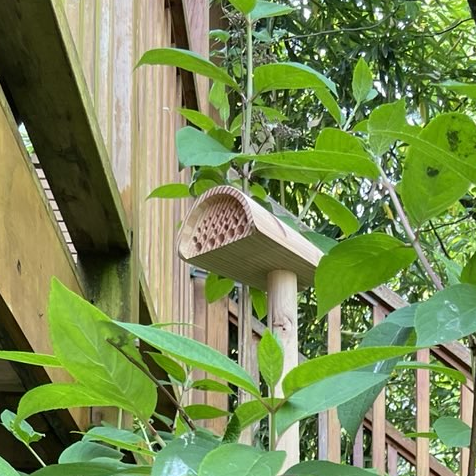
The purpose of the turner boxes is still difficult for me to wrap my head around. I think part of this is that there is no ‘purpose’ in a functional sense. Why bees? maybe it’s why not bees? if everything is part of these forever repeating entanglements, then it doesn’t really matter if its bees or something else. I think the place where design comes in is that designers make, designers do. So how can you make and do in the face of everything having reverb? acting in the face of not-knowing, while still trying your best to be responsible to relationality. We are making these nests that have relational technologies attached in the form of cameras. What is the purpose of the camera? What is it doing or not doing? It is facing in the opposite way of the nest entrance. It is sensing, but in what ways and for who’s gain? is it a gain? Is my initial feeling of a camera acting as surveillance not inherent in the technology but learned by how it has been used in the past? Maybe the camera is just another eye in a sea of watching without noticing. Irresponsible sensing? Here’s a blurb about the project from the EDS website:
“The aim of the Turner Boxes project is to investigate through design what a relationship might be with wild bees in urban settings in which we are neither stewards nor extractors–for shorthand we refer to this as “non-instrumental”. Arguably, there is a good case for not designing at all, especially with technologies, in ways that involve nonhuman species and ecologies. Especially, given that historically this has resulted in exploitation, extraction, and harm. Yet, in the context of cities and urban environments, nonhuman species and ecologies are irreversibly entangled in the same technological environment as us, a shared technicity (Haraway 1991, Ihde 1990) made up of radio frequencies, electricity, transportation, and so on. The technicity of urban environments impacts both human and nonhuman species. Yet, despite this, the systems and technologies we design and implement in cities are anthropocentric, human-centered such that interactions with nonhuman species is at best at the peripheries of concern and more than not simply overlooked.”
So maybe there is something here about trying to fit a square peg (anthropocentric technology: camera) into a round hole (nonhumans, here: urban bees). Maybe shaving down a square peg to fit the round hole? or at least to pass through in a way that doesn’t interfere? Urban bees most likely encounter cameras daily, most likely recorded by them as well, either intentionally or not (eg. someone sees a bee and takes a photo vs caught on a security cam). Maybe this is where the confusion begins, but a good confusion. Is this ‘staying with the trouble’? we design these technologies that are intended for human use but used in nonhuman settings. Still don’t have a great answer when someone asks “why bees?”… working on it! In the 2023 DIS paper, the words ambivalence and diffraction are used. I think that I need to use these more to frame my thinking of this project.
“The contribution is the theorizing of a design
position of diffraction in response to the ambivalences we experienced while designing the Turner Boxes that allowed us to move forward with our project.”
How to act in not-knowing?
The choice of bees is arbitrary perhaps, but in choosing a nonhuman to design alongside/with/for/through/all-the-words, we become responsible to act while causing the least amount of harm possible. But, we are clumsy humans. We are other-than-bees. We cannot begin to try to understand the needs of bees from their perspectives, we only know what we through observation – not communication. Or, maybe that’s not true. I picked up a bee on my run last week with a flower. It was laying on the concrete path, and whether it was dying or not, I could move it somewhere less likely to be squished, regardless of what may be happening for it. So as not to be stung, I plucked a flower off a nearby bush and offered it to the bee. It seemed to recognize the flower immediately, putting both of its arms (?) in the air reaching for it. It climbed on and I brought it back towards the bush. It began nestling into the flower as I set it down. Is this communication? I know bees are attracted to flowers through the work of past scientists, and through my own observations of course. Was that gesture a communication between me and the bee? did it even recognize I was there? Its something I can never know, I don’t have access to that. I can’t know.
I don’t know, and yet I make. You could argue that is how everything has been done – we never know and yet we continue on. Hindsight is 20/20, no? Perhaps there is some meta noticing – noticing that we have not noticed and now we are noticing while knowing we can’t notice all. … ok, that’s enough for now…
Second Project: Ocean Futures
context/method: storytelling? engagement? noticing?
Third project: Relational technologies
context/method: noticing/sensing
 Lauren Thu
Leave a comment