
“If our work becomes a catalyzing force for people to imagine things they would not have been able to imagine otherwise and act upon that imagination, then that’s powerful, and for me, this is a slow form of critical activism.“
Anab Jain, Calling for a More-than-Human Politics
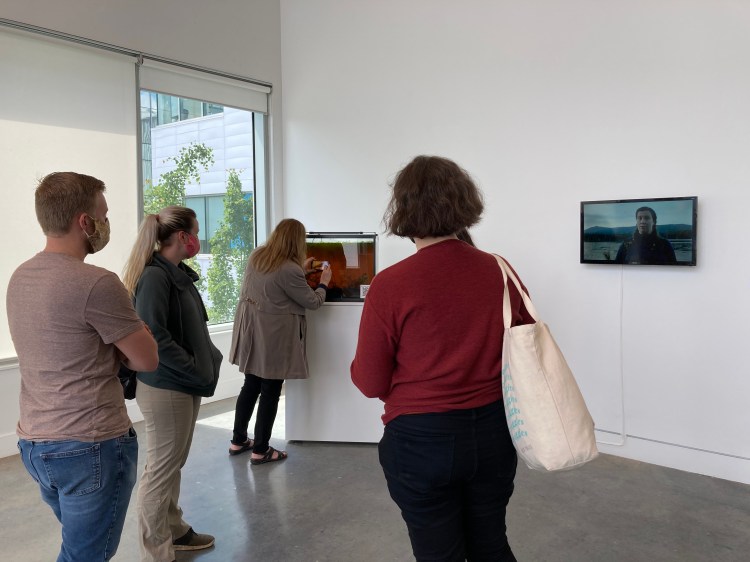
hirudinea lampyris uses a counterfactual narrative to reset the world that we live in. Positing a catalyst at the height of Taylorism, the Factory Riots of 1911 imagine an uproar against the publishing of Fredrick Taylor’s Principles of Scientific Management, and it’s allusion to imagination and idle thought being useless and frivolous. The collective shift away from the reverence of efficiency moves society towards a re-evaluation of thinking, making, and producing in general. Because of this, environmental destruction is scaled back and many species, unknown and extinct in our world, become champions of this world.
In this fiction, the Firefly Leech (hirudinea lampyris) is introduced as one of these champions. The leech is hematophagous, and through a chemical reaction between the hirudin in its saliva and the hormones in the food that it eats, the Firefly Leech displays the hormone levels of its last meal through bioluminescence in its skin. Through non-invasive metabarcoding, biologists are able to identify the host species the leech last fed on, and an empathetic profile on the ecosystem that it lives in.
Our sense for and ability to imagine is intrinsically tied to our hope for a future. Fiction is a way to open up our imaginations, design offers a way to stay open.
News
2021 grad show feature
ECUAD alumni feature
Awards
[2021] ECUAD DESIS Radical Sustainability Award
[2021] John C. Kerr Chancellor Emeritus Award for Excellence in Design
 Lauren Thu